At a glance
RECORDED PROFILE DATA- Scientific name
- Angraecum germinyanum Hook.f.
- Name status
- Accepted
- Native region
- Comoros, Réunion (Madagascar reported by some sources)
- Growth habit
- Epiphytic subshrub
- Cultivation temperature group
- Not documented (grower reports intermediate to warm)
- Flower colour
- White
- Spur length
- ≈12–13 cm
- Typical elevation
- 900–1500 m (reported for Madagascar populations)
- Fragrance
- None documented
Names and Taxonomy
The accepted scientific name is Angraecum germinyanum Hook.f., first published in Botanical Magazine 115: t. 7061 (1889) [2]. Kew’s Plants of the World Online lists this name as accepted and records its native range as the Comoros and Réunion [1]. Two homotypic synonyms are recorded: Arachnangraecum germinyanum (Hook.f.) Szlach., Mytnik & Grochocka and Mystacidium germinyanum (Hook.f.) Rolfe [1]. No common name is documented in the available sources.
How to Identify This Species
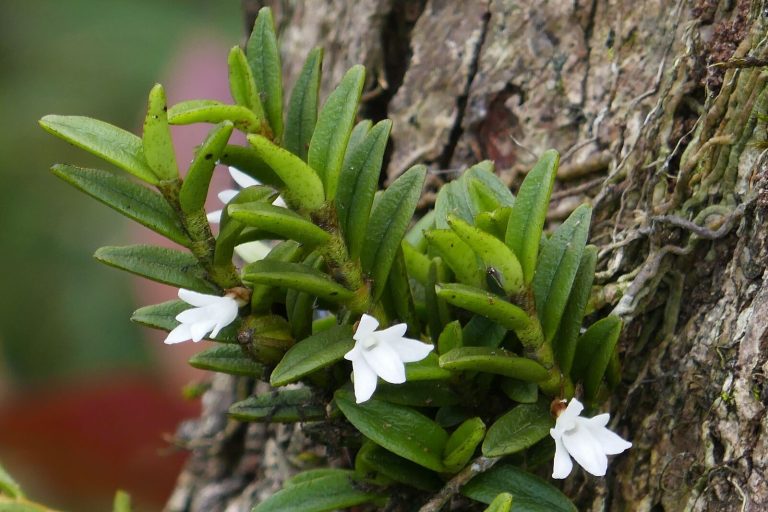
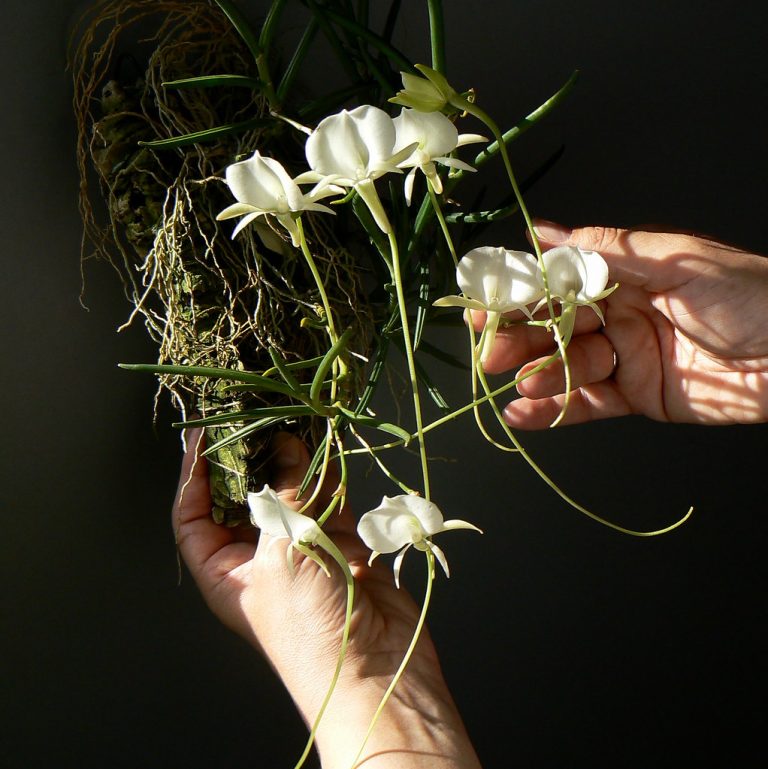
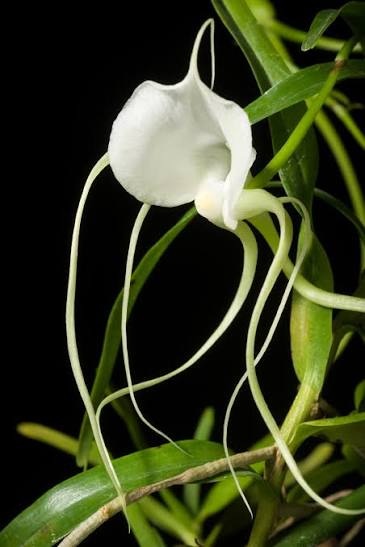
Angraecum germinyanum is a small‑to‑medium sized, pendant to scandent, monopodial epiphyte. It has an elongated, slender stem bearing distichous, linear‑oblong leaves that are bright glossy green and unequally bilobed at the apex [10]. The inflorescence is a solitary, wiry spike about 0.75 cm long, bearing a single white flower. The flower is non‑resupinate, with a long, slender spur measuring roughly 12–13 cm, and the overall flower length is about 8.5 cm [10]. The lip is turned upward, 1.7–2.3 cm high, with a pointed tip. The sepals and petals are twisted, each 7–10 cm long. The flower is not fragrant [10]. These characters, especially the exceptionally long spur and the twisted petals, help separate it from other compact Angraecum species.
Native Range and Habitat
According to Kew, the species occurs naturally in the Comoros and the island of Réunion, where it grows as an epiphytic subshrub in wet tropical forests [1]. Some horticultural sources report an additional distribution on Madagascar, noting occurrences on the central plateau at elevations of 900–1500 m [10]. The habitat is therefore a humid, montane forest environment, typically on tree trunks or large branches where moisture is abundant.
Species‑Specific Care
| Factor | Documented guidance | Source |
|---|---|---|
| Temperature | Intermediate to warm; daytime 22–28 °C, night 9–16 °C | [11] |
| Light | Medium shade, approx. 1000–2000 foot‑candles | [11] |
| Watering | Keep growing medium consistently moist; ensure good air flow to prevent rot | [11] |
| Humidity | Not documented in the sources | Not documented |
| Mounting / Potting | Can be grown mounted on bark or in a well‑draining orchid mix; compact habit suits small pots (≈6 cm) | [8] |
| Fertilisation | Regular orchid fertilizer during active growth; no specific regime documented | Not documented |
| Seasonal care | Maintain airflow; occasional systemic fungicide (e.g., Thyomil, Dithane 45) as preventive measure | [11] |
The most critical needs are a warm intermediate temperature range, bright but filtered light, and excellent ventilation to mimic its humid forest canopy origin. Over‑watering or stagnant air can lead to fungal problems, which growers mitigate with preventive fungicide applications.
Flowering and Pollination
Flowering occurs in the spring to early summer in cultivation, producing a single, long‑spur white flower that lasts several weeks [10]. The flower is reported as non‑fragrant [10]. No specific pollinator has been documented for this species; the long spur suggests adaptation to moth pollination, but this remains an inference rather than a confirmed observation.
Evidence and Limitations
Native distribution is clearly documented for the Comoros and Réunion by Kew, while other sources suggest a possible presence in Madagascar. Morphological details come from the Internet Orchid Species Encyclopedia, which provides measurements but does not cite primary herbarium data. Cultivation guidance is based on a single grower’s report; broader horticultural trials are lacking. Consequently, some aspects such as precise humidity requirements, formal pollinator identity, and conservation status remain undocumented.
FOLLOW THE EVIDENCE
Sources & references
- Angraecum germinyanum Hook.f. | Plants of the World Online | Kew Science (https://powo.science.kew.org/taxon/urn:lsid:ipni.org:names:616149-1)
- Angraecum germinyanum | International Plant Names Index (https://www.ipni.org/n/616149-1)
- Orchid Species: Angraecum germinyanum – Internet Orchid Species Encyclopedia (http://www.orchids.org/grexes/angraecum-germinyanum)
- Angraecum germinyanum – grower article by Tom Kuligowski (https://orchids.herokuapp.com/articles/angraecum-germinyanum)
- Angraecum germinyanum – commercial description (https://orchids-shop.com/products/angraecum-germinyanum)