At a glance
RECORDED PROFILE DATA- Scientific name
- Angraecum distichum Lindl.
- Name status
- Accepted
- Native region
- West & Central Tropical Africa, extending to Uganda and northern Angola
- Growth habit
- Epiphytic dwarf subshrub, forming small clumps
- Cultivation temperature group
- Warm (21‑32 °C)
Names and Taxonomy
Angraecum distichum Lindl. is the accepted name for this species according to Kew’s Plants of the World Online [1][2]. The name was first published in Edwards’s Botanical Register in 1835/1836 [3]. Several synonyms have been recorded, the most recent being Angraecum poppendickianum Szlach. & Olszewski, which is treated as a synonym of A. distichum [3]. No vernacular common name is documented in the cited sources.
How to Identify This Species
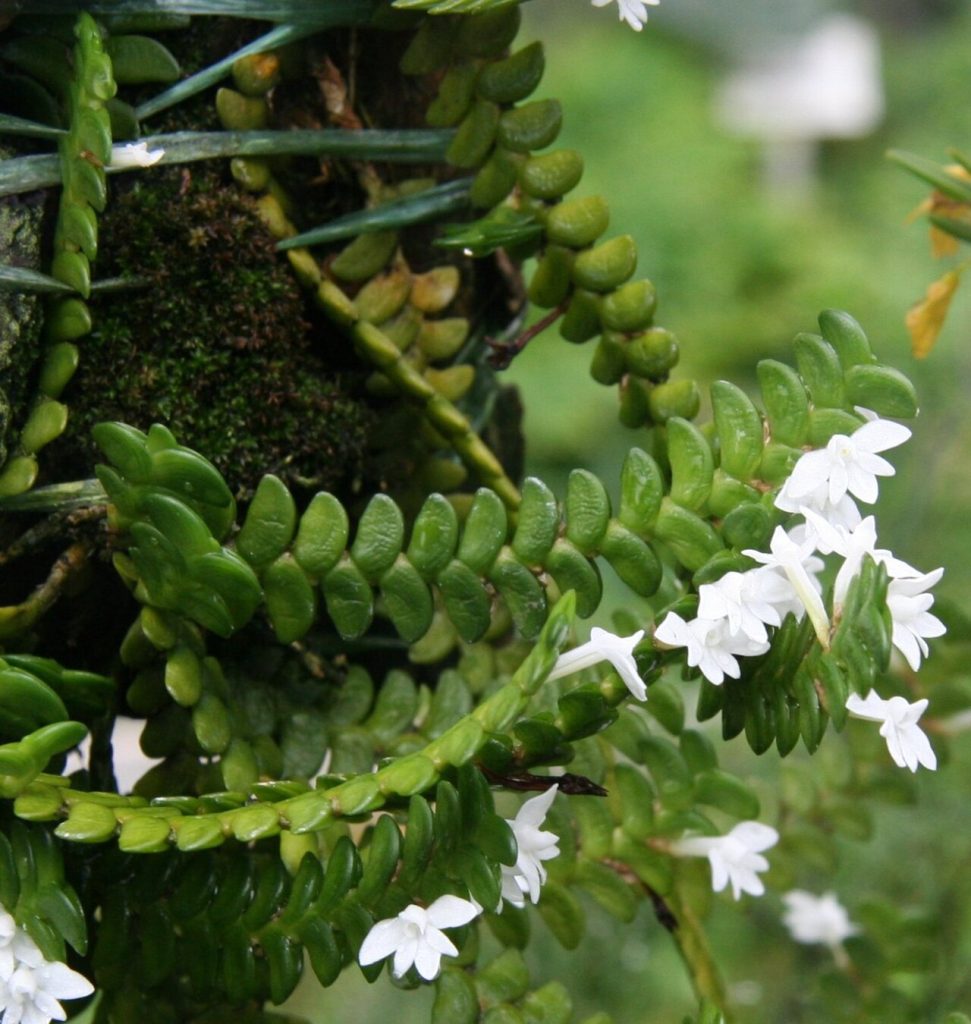
This dwarf epiphyte forms short, arcuate stems 3–25 cm long that are rarely branched [2]. Leaves are arranged in two opposite rows (distichous), triangular‑to‑fleshy, bright green and often described as “lockhartia‑like” [10]. The plant usually forms dense clumps up to about 15 cm (6 in) tall in the wild and in cultivation [11]. Roots are fine, about 0.5 mm in diameter [2].
The flower is solitary, axillary and appears on a very short stalk. Flowers are white, about 0.6 cm (¼ in) across, with a long, straight spur 9–10 mm long that contains fragrant jasmine‑scented nectar [10][12]. The lip and dorsal sepal are positioned opposite each other, a typical Angraecum feature. Flowering can occur throughout the year on mature plants [11][12]. These characters together distinguish A. distichum from other small Angraecum species such as A. affine, which has larger, less distichous leaves.
Native Range and Habitat
The species is native to a broad swath of West and Central Tropical Africa, extending east to Uganda and south to northern Angola. Documented countries include Angola, Benin, Burundi, Cameroon, Central African Republic, Congo, Democratic Republic of the Congo, Equatorial Guinea, Gabon, Ghana, Guinea, Guinea‑Bissau, Gulf of Guinea Islands, Ivory Coast, Liberia, Nigeria, Rwanda, Senegal, Sierra Leone, Togo and Uganda [1]. It grows as an epiphyte on large trees in humid, low‑land to sub‑montane rainforests, typically from 200 m up to 1 600 m elevation [10]. The preferred substrate is the bark of mature forest trees, where it receives filtered light and high atmospheric humidity.
Species‑Specific Care
| Factor | Documented guidance | Source |
|---|---|---|
| Light | Low to medium, bright‑indirect light; direct sun may scorch leaves. | [11] |
| Temperature | Warm range, roughly 21–32 °C (70–90 °F) day/night. | [11] |
| Humidity | High humidity, ideally >70 %; good airflow to prevent rot. | [11] |
| Mounting / Potting | Can be mounted on cork or tree fern slab; in pots use a coarse bark mix with sphagnum moss, keeping the medium well‑draining but moisture‑retentive. | [11] |
| Watering | Keep roots moist but not soggy; water regularly in the growing season, allowing brief drying periods. | [11] |
| Fertilising | Apply a balanced orchid fertilizer once a month during active growth. | [11] |
| Propagation | Side‑branch cuttings root readily in a bark mix; keiki (plantlet) formation at the base is common. | [11] |
| Rest period | Not documented; growers report year‑round growth and flowering. | [11][12] |
Because the species is slow‑growing, avoid frequent repotting; when necessary, do so in spring and keep the root ball intact. Over‑watering or disturbance of the fine roots can lead to rot, a common problem reported by growers [11].
Flowering and Pollination
Flowers are produced on new growth and may appear at any time of year, especially in cultivation where temperature and humidity are stable [11][12]. Each flower is short‑lived but the inflorescence can persist for weeks, providing a prolonged display. The fragrant, jasmine‑scented nectar spur suggests moth pollination, a typical syndrome in Angraecum, but specific pollinator observations for A. distichum are not documented in the available sources.
Conservation and Responsible Cultivation
The IUCN Red List assesses Angraecum distichum as Least Concern (LC) with a confident assessment [2]. While the species is not currently threatened, habitat loss in tropical forests could affect local populations. Cultivation from seed or vegetative propagation reduces pressure on wild collections.
Evidence and Limitations
Most morphological and ecological data come from horticultural observations and floristic checklists; precise measurements of flower dimensions and elevation range are limited to the ranges reported in IOSPE and grower notes. Pollinator identity, exact humidity percentages, and detailed phenology across the full native range remain undocumented.
FOLLOW THE EVIDENCE
Sources & references
- Angraecum distichum Lindl. | Plants of the World Online | Kew Science – https://powo.science.kew.org/taxon/616083-1
- Angraecum distichum Lindl. | Plants of the World Online – General information – https://powo.science.kew.org/taxon/urn:lsid:ipni.org:names:616083-1/general-information
- Angraecum distichum | International Plant Names Index – https://www.ipni.org/n/616083-1
- IOSPE PHOTOS – Angraecum distichum – https://www.orchidspecies.com/angdistichum.htm
- Angraecum distichum – BellaOnline – http://www.bellaonline.com/articles/art35525.asp
- Angraecum distichum – Orchids.org – https://www.orchids.org/articles/angraecum-distichum
