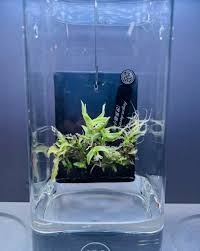
At a glance
RECORDED PROFILE DATA- Scientific name
- Angraecum decaryanum H.Perrier
- Name status
- Accepted by Plants of the World Online and IPNI
- Native region
- Southwestern Madagascar
- Growth habit
- Epiphytic subshrub / epiphyte
- Cultivation temperature group
- Conflicting labels: hot growing (IOSPE) vs intermediate (Clan Orchids compendium); thresholds not documented
- Flower size
- About 5 mm (IOSPE)
- Inflorescence
- 5–10 cm long, 1–4 flowers (IOSPE)
- Habitat elevation
- Up to 200 m (IOSPE)
- Flowering context
- Late fall reported by IOSPE; hemisphere and growing context not stated
- Common name
- De Cary's Angraecum (IOSPE)
Angraecum decaryanum H.Perrier is a small epiphytic orchid accepted by Plants of the World Online and IPNI, with a native range in southwestern Madagascar [1][2]. It is recorded as an epiphytic subshrub of seasonally dry tropical biome [1], and one specialist orchid encyclopedia describes it as a small, hot-growing epiphyte from dry regions and coastal forests at elevations up to 200 m [3]. Horticultural evidence is sparse and partly conflicting, so the care section below separates documented labels from inference and marks missing data as Not documented.
Names and Taxonomy
The accepted scientific name is Angraecum decaryanum H.Perrier. The basionym publication is given by POWO as Notulae Systematicae (Paris) 7: 129 (1938) [1]. Kew’s Species Data Portal lists the name as accepted under IPNI authority and gives the same authorship [2]. The homotypic synonym Lemurangis decaryana (H.Perrier) Szlach., Mytnik & Grochocka was published in Biodiversity Research and Conservation 29: 16 (2013) [1][2]. IOSPE places the species in Angraecum section Lemurangis [3].
No infraspecific taxa, varieties, or subspecies are documented in the supplied sources. IOSPE gives the English common name De Cary’s Angraecum [3], but common names are not standardized and should not be used as identification evidence. For nomenclatural purposes, Angraecum decaryanum is the name to use; Lemurangis decaryana is a synonym, not a separate species in this treatment. No hybrid status is documented.
How to Identify This Species
The documented habit is epiphytic: POWO calls it an epiphytic subshrub [1], and IOSPE describes a small, hot-growing epiphyte [3]. IOSPE reports a very long, slender stem carrying reddish, recurved, linear leaves that are keeled below [3]. The same source describes the plant as small-sized, but does not give a full stem length in the excerpt; a secondary database lists a height of 30 cm [5], but that figure is not independently corroborated in the supplied evidence and should be treated as provisional.
Flowers are the most diagnostic documented feature. IOSPE gives a flower size of about 0.2 in (5 mm) and an axillary inflorescence 2–4 in (5–10 cm) long, bearing one to four flowers, with a broadly oval, acute bract [3]. The same source reports flowering in late fall [3], but does not state the hemisphere or growing context for that observation. NativePlants.info lists white flowers and a fragrant scent [5], but it does not provide a detailed floral description, measurements, or fragrance timing; those traits should be checked against fresh flowers or a verified description before being used as firm identification characters. No lip or spur measurement for A. decaryanum was present in the supplied excerpts.
Identification from a label or photograph alone is unreliable. A cultivated plant should be confirmed from flower structure, inflorescence arrangement, and provenance. No documented look-alike comparison was supplied, so this profile does not claim a single visual feature as sufficient for separation from other small Madagascan Angraecum species.
Native Range and Habitat
The native range is southwestern Madagascar [1][3][4]. POWO records it as native to Madagascar and describes the species as occurring in the seasonally dry tropical biome [1]. IOSPE adds the habitat context of bushes and succulents in dry regions and coastal forests at elevations up to 200 m [3]. These are habitat observations, not cultivation setpoints. No introduced or naturalized records outside Madagascar were present in the supplied sources.
The species is documented as epiphytic in habitat [1][3]. The supplied evidence does not give host specificity, rainfall totals, humidity, or a detailed seasonal climate profile. Consequently, the native range and elevation should not be converted directly into greenhouse temperatures or watering intervals.
Species-Specific Care
Species-specific cultivation evidence is limited. The table below records only what the supplied sources state, and it keeps source disagreements visible rather than averaging them.
| Factor | Documented guidance | Evidence or context |
|---|---|---|
| Temperature | Conflicting labels: hot growing in IOSPE; intermediate (I) in Clan Orchids’ compendium. No numerical day/night thresholds documented. | IOSPE describes a hot-growing epiphyte [3]; Clan Orchids lists I [4]. The basis and thresholds for each label are not given. |
| Light | Not documented. | The Clan Orchids excerpt leaves the light column blank for this species [4]. |
| Watering | Medium (M) in one compendium; no schedule or seasonal adjustment documented. | Clan Orchids compendium [4]. This is an abbreviation, not a measured watering regime. |
| Feeding | Low (L) in one compendium. | Clan Orchids compendium [4]. No concentration or frequency is documented. |
| Humidity and airflow | Not documented. | No species-specific humidity or airflow values were supplied. |
| Potting or mounting | Not documented as a cultivation recommendation. | The species is epiphytic in habitat [1][3]; this supports an epiphytic growing approach in principle but does not specify a method. |
| Repotting | Not documented. | No species-specific repotting interval or medium was supplied. |
| Seasonal changes | Not documented. | No dry rest, winter rest, or seasonal temperature change is documented for cultivation. |
The most important practical point is that the care evidence is thin. IOSPE’s hot-growing label and Clan Orchids’ intermediate label are not interchangeable, and the excerpts do not explain whether they refer to the same growing context. A grower should record actual temperatures, airflow, and root behavior rather than treating either label as a verified threshold. Because the plant is epiphytic in nature, a mounted or very open epiphytic culture is plausible, but that is an inference from habitat, not a documented species-specific trial. No source supplied here supports a rigid watering schedule, a specific humidity target, or a dry rest for A. decaryanum.
Flowering and Pollination
IOSPE reports an axillary inflorescence 5–10 cm long with one to four flowers and a flower size of about 5 mm, flowering in late fall [3]. The same source does not state whether late fall refers to the Northern or Southern Hemisphere or to a particular greenhouse. NativePlants.info lists bloom months across January–December and gives white, fragrant flowers [5], but the basis for those entries is not detailed and conflicts with the more specific late-fall report. Until a location and observation context are known, the flowering season should be treated as incompletely documented.
Flower longevity, fragrance timing, nectar volume, and spur dimensions for A. decaryanum were not documented in the supplied evidence. Pollination is also Not documented for this species. Studies of long-spurred Madagascan Angraecum and hawkmoths are relevant to the genus but should not be applied to A. decaryanum without species-specific evidence. A recorded pollinator, a flower-shape hypothesis, and a genus-level pollination study are different levels of evidence and are kept separate here.
Conservation and Responsible Cultivation
No formal conservation assessment for Angraecum decaryanum was present in the supplied sources. This profile therefore does not assign an IUCN category, legal status, or trade status. The native habitat is described as seasonally dry tropical biome in southwestern Madagascar [1], with dry regions and coastal forests up to 200 m [3], but the supplied excerpts do not quantify habitat loss or population trends. Conservation status should be checked against a current formal assessment before being stated as fact. Responsible cultivation includes verifying provenance and legal sourcing where required, but no nursery or trade claim is made here.
Evidence and Limitations
This profile is based on search snippets and short excerpts, not on a full reading of the cited pages or papers. The accepted name and native range are supported by POWO and Kew Species Data [1][2]. Morphology, elevation, and flowering context come mainly from IOSPE [3], a specialist orchid encyclopedia whose observations are not independently verified here. Cultivation labels come from a general compendium [4], and the white-flower and fragrance notes come from a secondary native-plant database [5]. The 30 cm height, year-round bloom months, and fragrance claims from NativePlants.info are not corroborated by the other supplied sources and should be treated as provisional. No verified photographs, herbarium specimen images, full protologue, or formal conservation assessment were supplied. Identification and cultivation recommendations therefore remain limited by the available evidence.
Frequently asked questions
Is Angraecum decaryanum an accepted species?
Yes. Plants of the World Online and Kew Species Data list Angraecum decaryanum H.Perrier as accepted; Lemurangis decaryana is a homotypic synonym.
Where is Angraecum decaryanum native?
It is native to southwestern Madagascar. IOSPE also reports it from dry regions and coastal forests at elevations up to 200 m.
What temperature should Angraecum decaryanum be grown at?
The supplied sources conflict: IOSPE calls it hot growing, while Clan Orchids' compendium lists intermediate. No numerical day/night thresholds are documented.
How large are the flowers of Angraecum decaryanum?
IOSPE gives a flower size of about 5 mm and an inflorescence 5–10 cm long with one to four flowers. These measurements are from a single specialist source and are not independently verified here.
Is the pollinator of Angraecum decaryanum known?
Not documented in the supplied sources. Pollination studies of other Madagascan Angraecum species should not be assumed to apply to this species.
Related terminology
- Epiphyte
- A plant that grows on another plant for support, not as a parasite.
- Homotypic synonym
- A synonym based on the same type specimen as the accepted name.
- Seasonally dry tropical biome
- A tropical biome with a pronounced dry season.
FOLLOW THE EVIDENCE
Sources & references
- Angraecum decaryanum H.Perrier | Plants of the World Online | Kew Science. Royal Botanic Gardens, Kew. https://powo.science.kew.org/taxon/urn:lsid:ipni.org:names:616072-1
- Angraecum decaryanum. Kew Species Data Portal. https://species.data.kew.org/species/urn:lsid:ipni.org:names:616072-1
- IOSPE PHOTOS: Angraecum decaryanum H.Perrier 1938. Internet Orchid Species Photo Encyclopedia. http://www.orchidspecies.com/angdecareyanum.htm
- Angraecum Orchids, Orchid Care, Orchid Compendium. Clan Orchids. http://www.clanorchids.com/compendium/page3a.html
- Angraecum decaryanum (Angraecum decaryanum) | NativePlants.info. NativePlants.info. https://www.nativeplants.info/plant/magnoliophyta-flowering-plants/orchidaceae/angraecum/angraecum_decaryanum.html

