At a glance
RECORDED PROFILE DATA- Scientific name
- Angraecum bracteosum Balf.f. & S.Moore
- Name status
- Accepted
- Native region
- Réunion
- Growth habit
- Epiphytic subshrub
- Cultivation temperature group
- Warm to cool
Names and Taxonomy
The accepted scientific name is Angraecum bracteosum Balf.f. & S.Moore. The name is accepted by Kew’s Plants of the World Online, which records the original publication in J. Bot. 14:293 (1876) and lists the species as native to Réunion[1]. Documented synonyms include:
- Hadrangis bracteosa (Balf.f. & S.Moore) Szlach., Mytnik & Grochocka (2013)
- Listrostachys bracteosa (Balf.f. & S.Moore) Rolfe (1902)
- Saccolabium squamatum Frapp. ex Cordem. (1895)
No alternative common name is widely recorded; a French list gives a descriptive name “Angrec à nombreuses bractées”[3]. The species is therefore treated as a distinct, endemic taxon of Réunion.
How to Identify This Species
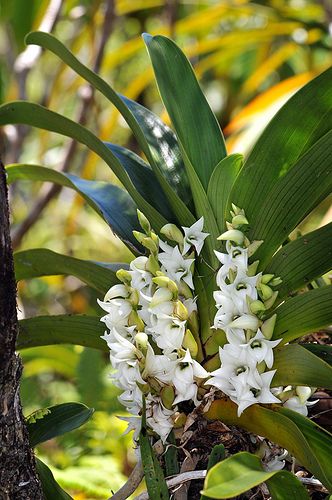
Growth habit: Small epiphytic subshrub forming short, erect stems that are basally sheathed. Mature plants reach 30–50 cm in overall spread[5][6]. Leaves are dark‑green, distinctly veined, ligulate and bilobed at the tip.
Flowers: Axillary, one‑sided racemes bearing numerous (≈10) flowers. Each flower is about 1.8–2.5 cm across, white (“snow‑white”) with a short, greenish spur of similar length (≈2–2.5 cm). The flowers are unscented[4][5]. Blooming occurs from December to April in the wild[5].
Because several Angraecum species share white, short‑spurred flowers, the combination of mid‑elevation habit, dense multi‑flowered racemes, and the specific leaf morphology helps separate A. bracteosum from related taxa such as A. cilaosianum or A. cornigerum, which differ in flower size or spur length.
Native Range and Habitat
The orchid is endemic to the island of Réunion in the Mascarene archipelago[1][2]. It occurs in humid, evergreen forest between roughly 600 m and 1 500 m elevation, most commonly on tree trunks and large branches where it grows as an epiphyte[5][6]. The forest is classified as a wet tropical biome, providing consistently high humidity and moderate temperatures.
Species‑Specific Care
| Factor | Documented guidance | Evidence |
|---|---|---|
| Temperature | Warm to cool conditions (typical of mid‑elevation tropical forests) | IOSPE description of “warm to cool growing epiphyte”[6] |
| Light | Not documented | — |
| Watering | Not documented | — |
| Humidity | Not documented (native habitat is humid) | — |
| Substrate | Epiphytic mounting on bark or tree‑fern fibre is appropriate | Growth habit listed as epiphytic[1][5] |
| Feeding | Not documented | — |
| Seasonal rest | Not documented | — |
Growers therefore treat A. bracteosum as a typical Mascarene epiphyte: mount on a well‑aerated bark medium, keep temperatures moderate (no frost, avoid prolonged heat >30 °C), and maintain good air circulation. Because specific watering, feeding, and rest‑period recommendations are not recorded in the literature, growers should observe the plant’s response and adjust accordingly.
Flowering and Pollination
In Réunion the species flowers from December through April, producing many small white flowers that lack fragrance[5][4]. A 2008 field study documented that the flowers are visited and effectively pollinated by white‑eyed Zosterops species (white‑eyes), an unusual bird‑pollination system for Angraecum[4]. Hand‑pollination experiments in the same study confirmed that the species is capable of setting seed when cross‑pollinated, indicating a primarily outcrossing breeding system.
Evidence and Limitations
Most morphological and ecological data come from regional floras and a focused pollination study. Detailed horticultural parameters such as precise watering frequency, fertilizer regime, or light intensity have not been published for this species, so the care table marks those items as “Not documented.” Future field observations and growers’ notes would be valuable to fill these gaps.
Frequently asked questions
What pollinates Angraecum bracteosum in the wild?
Field observations in Réunion show that white‑eyed Zosterops (white‑eyes) birds visit the unscented, short‑spurred flowers and act as the primary pollinators[4].
When does Angraecum bracteosum flower?
The species flowers from December to April in its native humid forest habitat[5].
Can Angraecum bracteosum be grown in a pot?
The orchid is epiphytic; growers typically mount it on bark or a very well‑aerated medium. Specific potting recommendations are not documented in the literature.
FOLLOW THE EVIDENCE
Sources & references
- Angraecum bracteosum Balf.f. & S.Moore | Plants of the World Online | Kew Science, https://powo.science.kew.org/taxon/urn:lsid:ipni.org:names:615986-1
- Angraecum bracteosum – Wikipedia (French), https://fr.wikipedia.org/wiki/Angraecum_bracteosum
- Index de la flore – Mascarine, https://mascarine.cbnm.org/index.php/flore/index-de-la-flore/nom?code_taxref=705821
- Micheneau, C. et al. (2008). Orchid–bird interactions: a case study from Angraecum and Zosterops on Reunion Island, https://doi.org/10.1139/b08-068
- Orchidées de nos forêts – Jean Claude Sertier, https://www.lansiv-kreol.re/environ_orchidees01.htm
- IOSPE PHOTOS – Angraecum bracteosum, https://www.orchidspecies.com/angbracteosum.htm