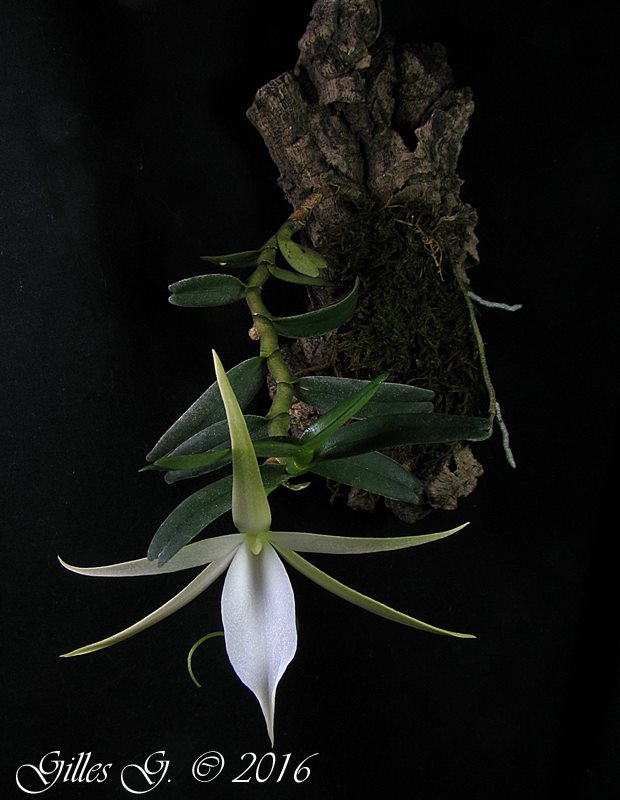
At a glance
RECORDED PROFILE DATA- Scientific name
- Angraecum bicallosum H.Perrier
- Name status
- Accepted by POWO; homotypic synonym Perrierangraecum bicallosum
- Native region
- Northern Madagascar
- Growth habit
- Epiphytic subshrub; miniature, pendant epiphyte per IOSPE
- Cultivation temperature group
- Cool-growing descriptor reported; no formal thresholds documented
- Flower size
- About 6 cm (2.4 in) per IOSPE
- Habitat elevation
- 1,000 to 2,000 m per IOSPE
- Flowering
- Spring reported by IOSPE; context not specified
- Common name
- The Two Calli Angraecum (IOSPE)
Angraecum bicallosum H.Perrier is an accepted orchid species native to northern Madagascar. It is an epiphytic subshrub in the wet tropical biome, and the horticultural literature describes it as a miniature, pendant, cool-growing epiphyte. The available evidence supports a clear taxonomic and habitat outline, but species-specific cultivation measurements are sparse; this profile separates documented habitat from provisional care context.
Names and Taxonomy
Angraecum bicallosum H.Perrier was first published in Notul. Syst. (Paris) 7: 111 (1938). Plants of the World Online (POWO) accepts the name and records the native range as northern Madagascar [1]. POWO lists one homotypic synonym: Perrierangraecum bicallosum (H.Perrier) Szlach., Mytnik & Grochocka, published in Biodivers. Res. Conservation 29: 19 (2013) [1]. The Internet Orchid Species Photo Encyclopedia (IOSPE) places the species in section Perrierangraecum and gives the common name The Two Calli Angraecum, referring to two small, obscure calli at the entrance to the spur [2]. No varieties or subspecies are documented in the supplied sources. The accepted name should be used for the canonical profile; the segregate name Perrierangraecum bicallosum is a synonym, not a separate species in this treatment.
How to Identify This Species
IOSPE describes A. bicallosum as a miniature, pendant epiphyte with branching, slightly compressed stems. The leaves are short, broadly elliptic, deeply and unequally bilobed at the apex, and conduplicate at the base [2]. The same source reports a flower size of 2.4 in (6 cm) and a very short, axillary, single-flowered inflorescence that is completely enveloped by three to four green sheaths and a similar green, folded floral bract [2]. The common name refers to the two small calli at the spur entrance, a floral detail that is more useful than general color in confirming identity [2].
A secondary horticultural database, NativePlants.info, lists a height of 30 cm, white and green bloom colors, and fragrant: yes [3]. Those entries are not accompanied in the supplied excerpt by measurement context or verification, and they should be treated as provisional rather than diagnostic. No species-specific look-alike comparison was supplied, so identification should not rest on a single photographic feature. A confident determination requires flowers, vegetative arrangement, provenance, and, where possible, comparison with authenticated herbarium material or expert determination.
Native Range and Habitat
POWO records A. bicallosum as native to northern Madagascar and describes it as an epiphytic subshrub growing primarily in the wet tropical biome [1]. IOSPE gives a more specific habitat account: mossy, lichen-rich forests on tree trunks at elevations of 1,000 to 2,000 m [2]. That elevation range is a habitat observation, not a cultivation setpoint. No introduced or naturalized records are documented in the supplied sources, and no host-tree specificity is documented. The CITES identification guide for commercialized Malagasy endemic orchids also lists Angraecum bicallosum H. Perr., which supports its treatment as a Malagasy endemic in trade-identification context [4].
Species-Specific Care
The supplied evidence does not include a species-specific cultivation trial with measured temperature, light, watering, or humidity values. The table below therefore separates documented descriptors from missing guidance.
| Factor | Documented guidance | Evidence or context |
|---|---|---|
| Temperature | No precise day, night, or seasonal setpoints documented. IOSPE describes a cool-growing epiphyte; habitat elevation is 1,000 to 2,000 m. | Cool descriptor and elevation from IOSPE [2]; elevation is habitat context, not a greenhouse target. |
| Light | Not documented. | Habitat is mossy, lichen-rich forest on tree trunks [2], but no cultivation light measurement is supplied. |
| Watering | Not documented. No schedule or dry rest is supported. | No species-specific watering trial in the supplied sources. |
| Humidity and airflow | Not documented as cultivation targets. | The habitat description is mossy and lichen-rich, but no humidity or airflow figures are supplied [2]. |
| Potting or mounting | Not documented. The plant is described as pendant and epiphytic. | Habit from IOSPE [2]; specific pot, basket, or mount trials are not in the supplied sources. |
| Feeding | Not documented. | No species-specific fertilizer evidence supplied. |
| Repotting | Not documented. | No species-specific repotting interval or medium supplied. |
| Seasonal changes | No documented rest period. Flowering is reported in spring by IOSPE. | Spring report from IOSPE [2]; no seasonal culture change is specified. |
Care should remain explicitly provisional. The most defensible statement is that A. bicallosum is a pendant epiphyte from cool, mossy, lichen-rich forest at 1,000 to 2,000 m [2]. That does not justify converting elevation into a thermostat setting, assuming a dry rest, or applying a generic Angraecum schedule. Growers who cultivate the species should record named-source conditions, including whether plants are mounted or potted, the medium, airflow, seasonal temperature range, and watering regime. Until such species-specific records are available, essential care values should be marked Not documented rather than guessed.
Flowering and Pollination
IOSPE reports that A. bicallosum blooms in spring on an axillary, very short, single-flowered inflorescence, with a flower size of 2.4 in (6 cm) [2]. The source does not specify whether spring refers to the Southern Hemisphere, the Northern Hemisphere, or a particular cultivation context, so the month should not be transplanted to a local calendar without qualification. NativePlants.info lists bloom months from January through December and lists the flowers as white and green and fragrant [3]. That broad listing conflicts with the more specific spring report and may reflect cultivation or database convention rather than wild seasonality; it is treated here as a secondary, unverified record.
Flower longevity, fragrance timing, nectar-spur length, and pollination biology are Not documented in the supplied sources. The two calli at the spur entrance are a morphological feature reported by IOSPE [2], not evidence of a particular pollinator. No pollinator observation or pollination experiment is supplied, so any pollinator statement would be inference rather than a documented record.
Conservation and Responsible Cultivation
No formal conservation assessment for A. bicallosum is documented in the supplied sources. The CITES guide lists the species among Malagasy endemic orchids that are commercialized, which is a trade-identification and trade-context signal, not an IUCN Red List category or a legal status determination [4]. Growers should verify provenance and any required permits before acquisition, and should not assume that a nursery purchase is legally compliant without documentation. Because habitat and trade context are documented but population status is not, conservation statements should remain limited to those facts.
Evidence and Limitations
This profile is based on search-result excerpts, not full-page or full-paper verification. POWO supports the accepted name and native range [1]; IOSPE supplies the principal morphological, habitat, elevation, and flowering details [2]; NativePlants.info supplies secondary horticultural entries that conflict in part with IOSPE [3]; and the CITES guide supports the commercialized-endemic context [4]. Material gaps include the absence of species-specific cultivation measurements, a formal conservation assessment, pollinator data, flower longevity, fragrance timing, and a documented look-alike comparison. The 30 cm height and January through December bloom listing from NativePlants.info are not independently verified here. This draft should not be described as botanically reviewed or publication-ready.
Frequently asked questions
Is Angraecum bicallosum an accepted species?
Yes. Plants of the World Online accepts Angraecum bicallosum H.Perrier. Perrierangraecum bicallosum is listed there as a homotypic synonym.
Where is Angraecum bicallosum native?
POWO records it as native to northern Madagascar. IOSPE reports it in mossy, lichen-rich forest on tree trunks at 1,000 to 2,000 m.
What temperature should Angraecum bicallosum be grown at?
Precise temperature thresholds are not documented in the supplied sources. IOSPE describes it as a cool-growing epiphyte, but habitat elevation should not be converted directly into a greenhouse setpoint.
When does Angraecum bicallosum flower?
IOSPE reports spring flowering without specifying hemisphere or cultivation context. NativePlants.info lists January through December, a conflicting secondary record that should be treated cautiously.
Is Angraecum bicallosum fragrant?
NativePlants.info lists fragrant: yes, but the supplied excerpt does not give fragrance timing or independent verification. This is a secondary horticultural record.
Related terminology
- Epiphytic subshrub
- A plant with a woody or subwoody base that grows on another plant; POWO uses this habit term for Angraecum bicallosum.
- Homotypic synonym
- A synonym based on the same type specimen; Perrierangraecum bicallosum is a homotypic synonym of Angraecum bicallosum.
- Callus (plural calli)
- A small thickened protuberance; IOSPE says the common name of Angraecum bicallosum refers to two small calli at the spur entrance.
FOLLOW THE EVIDENCE
Sources & references
- Angraecum bicallosum H.Perrier. Plants of the World Online, Royal Botanic Gardens, Kew. https://powo.science.kew.org/taxon/urn:lsid:ipni.org:names:615970-1
- IOSPE PHOTOS: Angraecum bicallosum H.Perrier 1938. Internet Orchid Species Photo Encyclopedia. https://www.orchidspecies.com/angbicallosum.htm
- Angraecum bicallosum (Angraecum bicallosum). NativePlants.info. https://www.nativeplants.info/plant/magnoliophyta-flowering-plants/orchidaceae/angraecum/angraecum_bicallosum.html
- Guide pour l’identification des orchidées endémiques malgaches commercialisées. CITES PC20 Inf. 11 Annexe 5, 2011. https://cites.org/sites/default/files/common/com/pc/20/inf_docs/F20-11i-A5.pdf

